
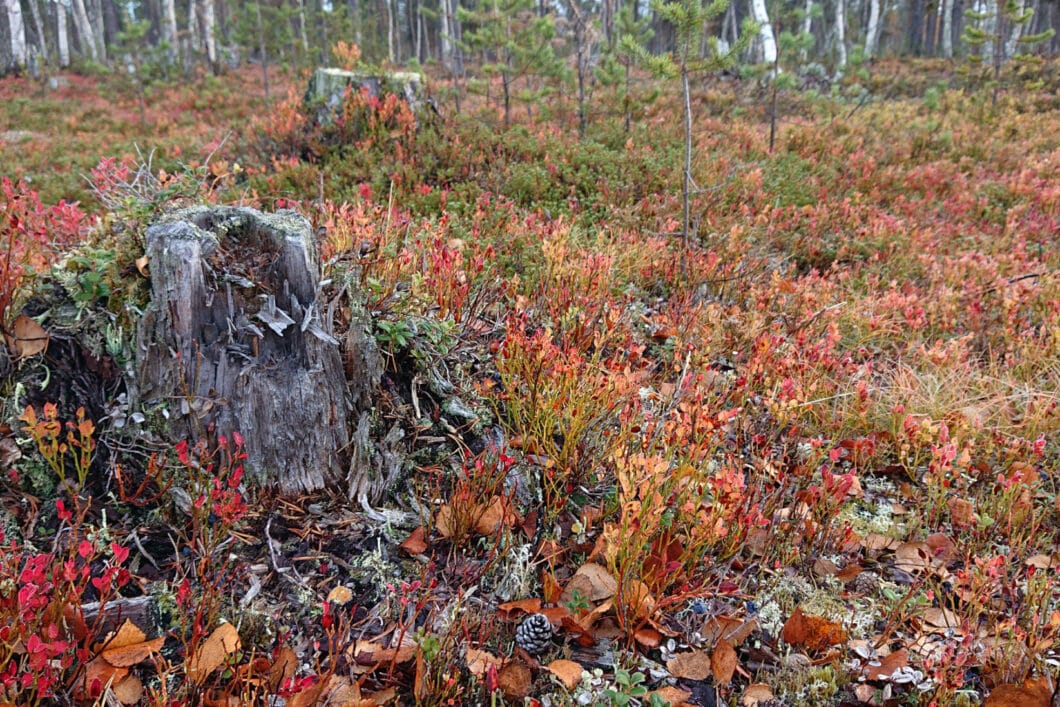
Ruska in Lapland: when the autumn colours peak in Saariselkä
Ruska is the autumn colour phenomenon of Lapland, when birches, rowans and the dwarf shrubs on the fells turn yellow, orange and red. In the Saariselkä and Inari region, ruska is typically at its best during the second week of September, and the display lasts around two to three weeks. Saariselkä suits an autumn hiking trip because it is the main gateway to Urho Kekkonen National Park, with both short day routes and longer treks starting nearby. The exact timing varies from year to year depending on the weather, so it is worth following forecasts when planning your trip.
Autumn in Lapland is a short but striking period when the fell landscapes glow with colour and the summer mosquitoes have already gone. Saariselkä is one of Finland’s best known autumn destinations, as Urho Kekkonen National Park and its extensive trail network spread out right next to the village. The area offers easy day trips for families as well as more demanding treks for experienced hikers.
This guide covers when ruska is at its best in Saariselkä, which are the best autumn routes, what gear to pack and how to arrange accommodation as a base for your trip. Ruska is the busiest season in the national park, so both accommodation and reservable hut beds should be booked well in advance. You can book accommodation for your autumn trip directly from Kuukkeli and set off straight from the village centre.
When is ruska at its best in Lapland?
The autumn colours move across Lapland from north to south at a pace of roughly fifty kilometres per day. They first ignite in Utsjoki and Kilpisjärvi as early as the first week of September. In the Saariselkä and Inari region the peak of ruska usually arrives during the second week of September, often around the tenth of the month.
The autumn colour season lasts around two to three weeks in a given area. It begins as the birches turn yellow and the rowans turn red, and it ends when the autumn winds bring the leaves down. The fell tops change colour first, and the front of colour moves down the slopes into the valleys.
The timing varies from one year to the next depending on the weather. A warm early autumn delays the colours, while the first night frosts bring them forward. To improve your chances of catching the best colours, follow the forecasts and aim for mid-September, but be prepared for the landscape to change quickly within a few days.
Why is Saariselkä an excellent ruska destination?
Saariselkä is the main gateway to Urho Kekkonen National Park, and a large share of the park’s routes start from the village or its immediate surroundings. The national park is the second most visited in Finland, and its round-topped fells, clear rivers and old-growth forests are in full colour during ruska.
Saariselkä’s advantage for the autumn hiker is accessibility. You can walk from the village to your own trailhead, and the nearest airport in Ivalo is about thirty kilometres away. Alongside accommodation, the area offers restaurant, café and rental services under one roof, so the trip can be made comfortable without long transfers.
Saariselkä works as a base for hikers of every level. Short day routes are manageable even with children, and for longer treks the park has the densest network of wilderness huts in Finland. Read detailed route descriptions and hut information in the hiking guide to Urho Kekkonen National Park.
The best autumn routes in Saariselkä
The Saariselkä and Kiilopää area has a marked trail network that is well suited to day trips. An autumn route can be a nature trail of a couple of kilometres or a full day’s hike, so there is a suitable option for everyone. Below are some of the most popular routes, from the shortest to the longest.
- Kaunispää is the easiest way to see the autumn scenery. The route from Saariselkä village to the summit is about 2 km each way, and the top opens up views in every direction.
- The Aurora Trail starts at the Saariselkä trailhead at the end of Lutontie road. The route is illuminated, and along the way there is the Aurora day hut and an outdoor fireplace. It is suitable for everyone, including families with children.
- The Iisakkipää route starts from the Saariselkä gateway and offers two options: the shorter route of about 3 km circles through the gorge scenery, and the longer route of about 7 km climbs to the summit of Iisakkipää.
- Rumakuru is a loop trail starting from the Saariselkä gateway that passes through a steep-walled gorge shaped by the Ice Age. The total distance is about 14 km and it takes four to six hours.
- Kiilopää lies about 15 km south of Saariselkä. Kiirunapolku leads to the summit of the 546-metre fell, from where wide fell panoramas open up.
A hiker ready for a longer trek can head into the heart of the park, for example to Lake Luirojärvi, from where you can climb Sokosti, the highest fell in the park. Multi-day treks like this require navigation skills, as not all routes are marked in the terrain. Getting started is easy when you rent your gear on site. Kesport equipment rental at Kauppakeskus Kuukkeli serves both hikers and cyclists.
Autumn holiday in Lapland: ruska, northern lights and peace and quiet
An autumn holiday in Lapland offers more than just hiking. In autumn the days are still bright but the nights are already dark, so the northern lights begin to appear in the northern sky. You can therefore combine an autumn hike with aurora watching on the same trip. Read the tips in our northern lights trip to Lapland guide before you go.
You can also admire the autumn foliage from the saddle of a bike. The Saariselkä and Kiilopää area has well over a hundred kilometres of marked mountain bike trails, and an electric fatbike takes you easily into the fell landscapes. A quieter day can be spent enjoying the area’s services. Bistro & Café Kuukkeli is a good place to enjoy a warm meal before or after your trip.
If you want to explore the area more widely, take a look at the activities in Saariselkä. On an autumn holiday you can experience both the colours of ruska and the first signs of the coming winter.
Gear and weather for an autumn trip
In September, daytime temperatures in Lapland typically range between five and fifteen degrees, but night frosts are common. The first snow can fall as early as September, so layered clothing, a windproof jacket and waterproof footwear are needed. It is also worth packing a warm change of clothes.
When moving in the national park, responsibility for safety lies with the hiker. Take a map and compass with you, as mobile phones do not have coverage everywhere in the park. In the national park, making a fire is allowed only at marked campfire sites, and open fires are forbidden during a forest fire warning.
Autumn is the busiest season in the national park. The trailhead car parks and open wilderness huts fill up easily, so it is best to set off in the morning. If you plan to stay overnight in a reservable hut, book a bed in advance through Eräluvat.fi. For a self-guided trip it is also worth packing a tent just in case.
Accommodation for an autumn trip in Saariselkä
Saariselkä is a natural base for an autumn trip, as the trails start right from the village and the services are close by. Kuukkeli offers a wide range of accommodation for groups of different sizes. The Teerenpesä suites and apartments are ideal for larger groups and families, while the cosy Hirvas Suite is a good choice for couples. Those looking for something more impressive can choose Villa Aurora Pupula or Aurora Resort.
Because autumn is a popular season, accommodation should be booked well in advance. You can see all accommodation options in Saariselkä and compare them at your leisure before booking. If you wish, you can also get around the area by rental car, which makes even the more distant trailheads easy to reach. Take a look at car rental in Saariselkä.
Book accommodation for your ruska trip in Saariselkä and experience Lapland’s autumn in full colour.
Frequently asked questions about ruska in Saariselkä
When is ruska in Saariselkä?
In the Saariselkä and Inari region, ruska is typically at its best during the second week of September, often around the tenth of the month. The exact timing varies from year to year depending on the weather.
How long does ruska last?
The ruska season lasts around two to three weeks in a given area. It begins as the birches turn yellow and ends when the autumn winds bring the leaves down.
Which is the best autumn route for beginners?
For beginners and families with children, the short Kaunispää route and the illuminated Aurora Trail are the best options. Both start near Saariselkä village and require no fell hiking experience.
Can you see the northern lights during ruska?
Yes. In September the nights are already dark, so you can see the northern lights in the northern sky on clear nights. An autumn hike can therefore be combined with aurora watching.
Should accommodation be booked in advance?
Yes. Ruska is the busiest season in the national park, and accommodation fills up quickly. Both accommodation and reservable hut beds should be booked well in advance.